AI Prospect Training
A practical way for Territory Managers to use AI to research an account before they ever walk in.
- My role
- Program creator & trainer
- Scope
- Curriculum, printed guide, prompt systems & workshops
- Client
- Hi-Line, Inc.
- When
- 2025 to present
The thinking.
Close the gap between a tool everyone was talking about and a field team with no idea what to do with it.
The challenge
AI was everywhere in conversation and nowhere in the field. Territory Managers had heard they should be using it, but nobody had shown them what that looked like on a Tuesday morning before a cold call. Generic training was never going to land either. These are people who work out of a van, sell industrial hardware face to face, and have no patience for anything that does not earn its place in the routine. The gap was not interest. It was a concrete, repeatable thing to do.
My contribution
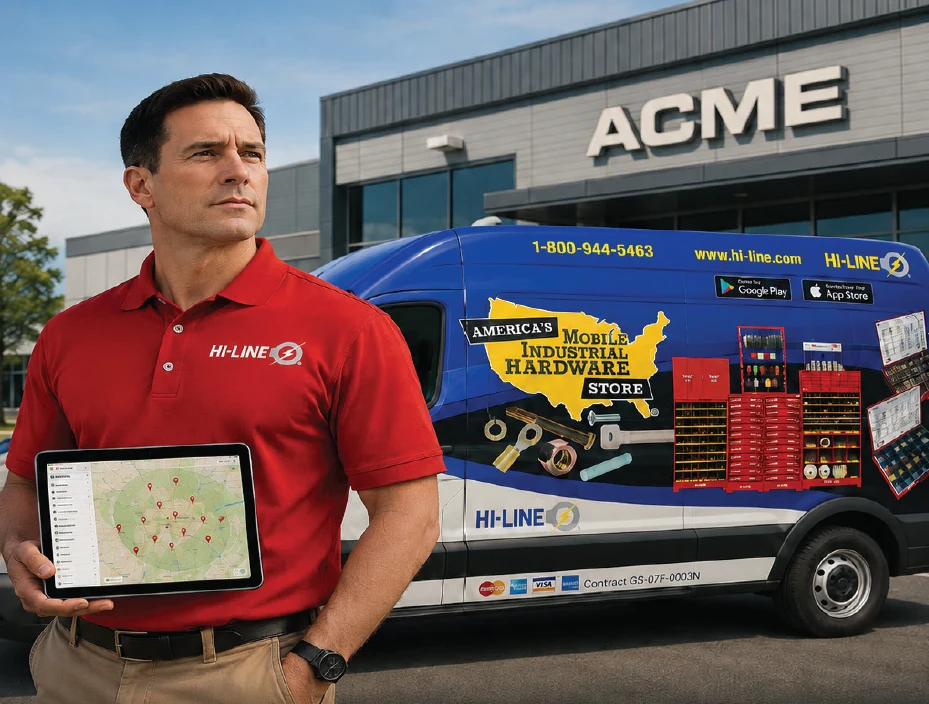
I built the program and taught it. A printed Territory Manager guide they could keep with them, with chapters on the approach before a visit, the follow up after it, and how to re-engage an account that has gone quiet. Live workshops where we worked real accounts instead of hypothetical ones. Ready-made prompts they could run without learning to write their own. And the workflow underneath all of it: pair a chat assistant with a map, scope an industrial area, size up who is in it, and be ready for the conversation in minutes.
The point of view
Training works when it survives contact with the job. Not a demonstration of what the technology can do, but a specific thing to do on Tuesday morning, with the words already written down.
The making.
The system, the applications,
and the details that connect them.
What it made
possible.
Researching the account stopped being the step that got skipped.
More than a hundred Territory Managers went through the program, and it is part of onboarding now. Prep that used to take an hour, and therefore often did not happen, takes minutes. They walk in knowing what the account makes and what it buys, so the first conversation starts somewhere real instead of with a generic pitch. They plan smarter stops across an area instead of knocking on every door, and they go after dormant accounts on purpose rather than writing them off. Cold calls got easier for the simple reason that walking in informed removes most of what makes them hard. The part I did not plan for: most of them outgrew my starter prompts. They write their own now, tuned to their own territory, which is the only real proof that a training stuck.
A brand to build. A story to tell.
A problem worth solving.
Not everything lives on this site. Reach out for more.